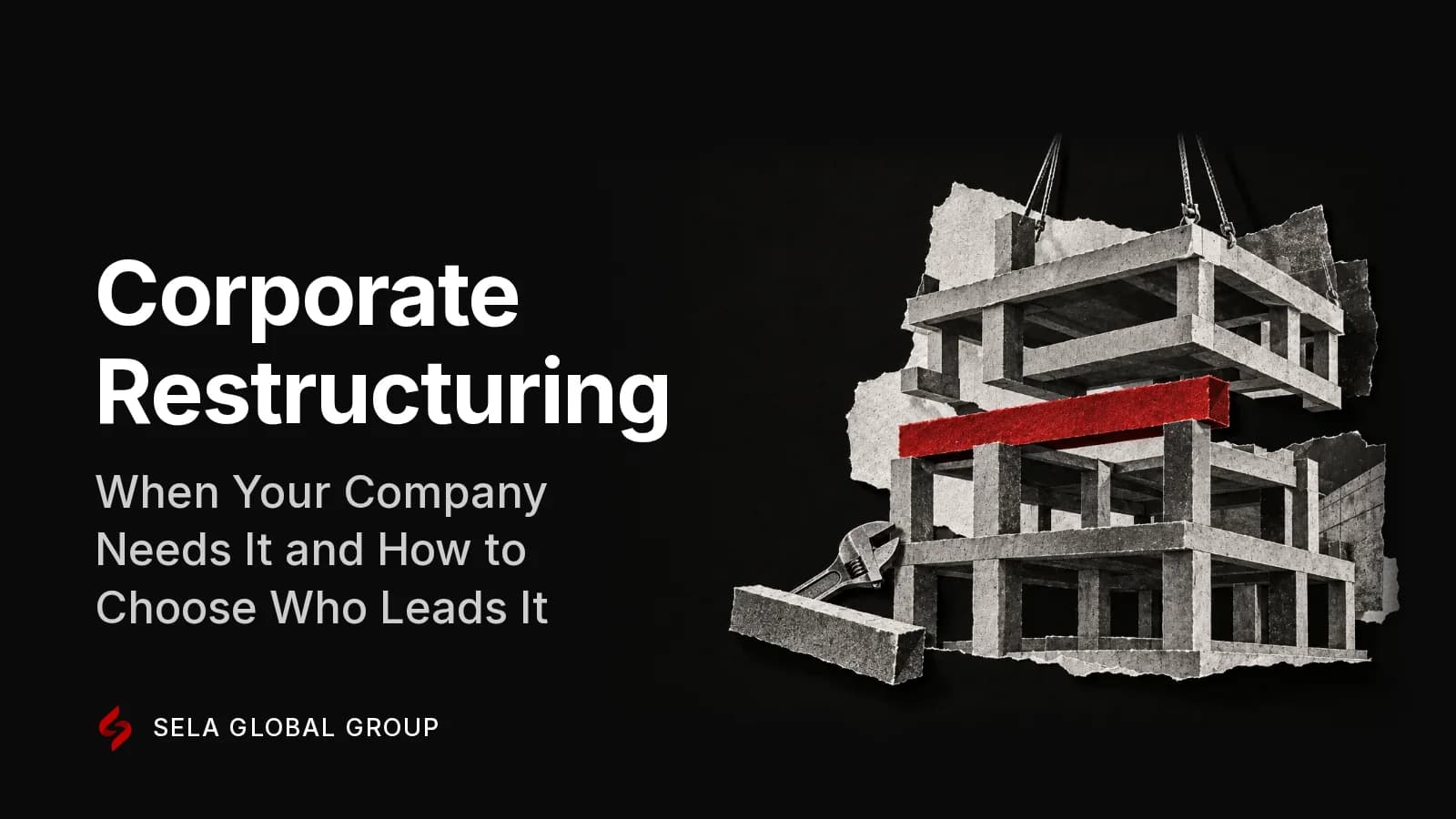
Corporate restructuring is redesigning how a company is organised, meaning its departments, roles, authorities and decision paths, and sometimes its operations or financial obligations, so that it fits its current strategy and size. Your company needs it when the same problems keep recurring however often the people change, because the fault then lies in the organisation, not in individual performance.
This guide, for company owners and leaders in Saudi Arabia, covers the types of corporate restructuring, the signs you need it, what it covers, how to run it without stalling the business, why it stalls, and how to choose who leads it.
What is corporate restructuring, and what types are there?
At its core, corporate restructuring is a decision to change how the company is organised to deliver its strategy: who reports to whom, who decides what, and how work flows between departments. It isn't drawing a new organisation chart; the chart is its final output, not its starting point.
At SELA, we lead organisational restructuring within our operations management track, together with organisational structure, the authority matrix, process redesign and KPIs, because changing any one of them alone doesn't hold if the others stay as they were.
The term covers four different kinds of change, each with its own question and its own lead:
| Type | What it changes | When it comes up | Usually led by |
|---|---|---|---|
| Organisational | Departments, roles, authorities and decision paths | Growth, expansion or overlapping responsibilities | Senior leadership with a management consultant |
| Operational | Processes, resources and how the service is delivered | Waste and delays, or a change in the business model | Operations teams with a management consultant |
| Financial | Debt, capital and obligations | Cash pressure or difficulty meeting repayments | A financial adviser and lawyer, with the creditors |
| Legal and ownership | Legal form, subsidiaries and ownership | A new partner, a merger or separating a business line | A lawyer and financial adviser |
This guide focuses on organisational and operational restructuring, which is what most companies mean by corporate restructuring. The financial and legal sides have their own specialists; in Saudi Arabia the second is governed by the Companies Law, including its provisions on converting and merging companies.
The four types often overlap, though. A merger of two companies is a legal and financial decision, and it always brings an organisational question: how two departments are combined, who leads each function, and which procedures survive. If nobody plans for that question early, the new company keeps working two ways at once.
When does your company need corporate restructuring?
Not every problem means the company needs a new structure. Some are caused by one person in the wrong seat, or a procedure that needs tightening. But when the same problem keeps coming back as the people change, the organisation itself probably no longer fits the company.
The clearest sign is decisions waiting for one person. A company that started with a founder deciding everything grows to a size their time can't cover, yet authority isn't delegated because it was never written down. The fix starts with defining who decides what, as we explain in our guide to organisational structure and the authority matrix.
The second sign is a change of strategy. A company entering a new sector or opening branches in other cities can't run that with a structure built for one activity in one location. The old rule still holds: structure follows strategy, not the other way round.
The third is accumulated layers. When a supervisory role is added to solve each new problem, the path between the people serving customers and the people deciding grows longer. Ask how many levels separate the front line from the decision, and whether each level owns a real decision or only passes paper along.
The last is a change in ownership: a new partner with capital and expectations, or a second generation taking over. Both change who decides, so the structure and authorities need updating before differences of opinion become a dispute.
When don't you need it? When the problem is one process that can be redesigned, a skill gap that needs training, or a leader not doing the job. Then changing the whole structure is bigger than the problem, and turns the company's attention away from its customers.
What does organisational restructuring cover?
Many people think corporate restructuring means moving boxes on the organisation chart. But the chart is one of five connected layers, and changing it alone produces a new chart with the old way of working carrying on underneath.
The order matters. The operating model is derived from the strategy, and the structure from the operating model, not from today's department names or the people currently in post. The common mistake is designing the structure around particular individuals, so the names change and the problem stays.
A key operating model question is what to run centrally and what to leave to branches or business units. Procurement and finance may gain from being central, while customer service needs decisions close to the front line. Settling that before drawing the structure saves long arguments about boxes.
Authorities are the layer most often neglected. A new department without written authorities will push its decisions upwards just as before. So the new structure comes with an updated authority matrix and job descriptions, so every manager knows the limits of their decisions from day one.
The process layer is where restructuring meets reengineering. Restructuring changes who owns the work; reengineering changes how it gets done. If the problem lies in a process that crosses several departments, you may need business process reengineering before moving departments, or alongside it.
By the end of the design, the company should hold four approved outputs: an organisational structure with clear reporting lines, an authority matrix, descriptions of the key roles, and a transition plan. If any one is missing, part of the decision is still open.
How to run a restructuring without stalling the business
Corporate restructuring succeeds when it's treated as a change project with stages and approved decisions, not an announcement made in a meeting. Its steps follow our method on every project: diagnose, design the model and plan, execute, then follow up and improve, with one party accountable to you.
Diagnosis starts with what actually happens: how a purchase, a hire or a customer discount gets decided, who is consulted and how long it waits. The published chart shows who reports to whom; tracing real decisions shows who actually decides, and where things get stuck.
- 1Diagnose the current stateInterviews, data and tracing real decisions, not just the published chart.
- 2Link to strategyWhat the new organisation must do well, and how its success is measured.
- 3Design the optionsTwo or three structural options, each with its benefits and risks.
- 4Approve design and authoritiesThe structure, authorities and roles, approved by senior leadership.
- 5Plan the transitionSequence, timing and communication, and who fills each new role.
- 6Implement in stages, follow upA phased transition, KPIs, and a review after implementation.
Don't skip designing options. Comparing two or three, each with its benefits and risks, gives leadership a real choice rather than a single recommendation, and shows what change the company will accept before anything is announced.
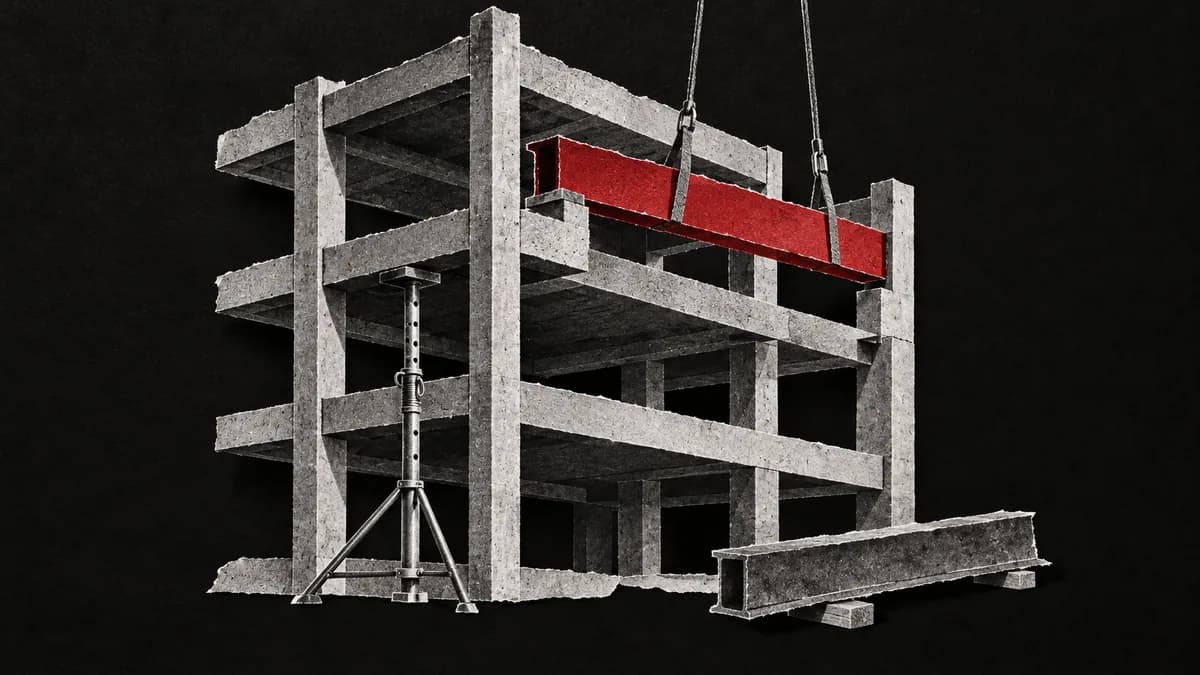
The most neglected step is the transition plan. A good design can be undone by a surprise announcement, by moving every department at once, or by new roles nobody fills. A phased transition keeps customers served during the change, like replacing a beam in a standing building while a temporary prop holds the floor.
At each stage, say what stays the same. People tolerate change when they know where they stand, and resist it when everything seems up for grabs. Write the new procedures in the language of those who will follow them, as we explain in our guide to preparing a policies and procedures manual.
If the new structure changes job titles, duties or work locations, check its effect on employment contracts and on the work regulations set up through the Qiwa platform (in Arabic), and take legal advice before the announcement, not after.
Why corporate restructuring stalls
Many corporate restructuring projects end with a new chart on the wall and a way of working that hasn't changed. The causes are well known, and you can avoid them if you know them before you start:
- Designing around people: a structure tailored to whoever holds each post today, which breaks when they move on.
- The chart without the authorities: new departments with no written decision limits, so decisions drift back upwards.
- Announcing before the plan: a team that hears about the change before its roles are settled, so rumours spread and the best people leave.
- Constant change: a restructuring every year or two, until the team stops trusting any structure.
- No measurement: no indicators before and after, so nobody knows whether the goal was met.
- Ownership left unsettled: a new management structure built on top of an unresolved disagreement between owners or partners.
What these share is that the project was treated as a paper decision rather than a change in how people work. That's why restructuring can't be separated from change management: explaining the reason before the shape, involving managers in the design, training those whose roles change, and following up on who is resisting and why.
A new structure also needs time to settle: early confusion over roles and authority doesn't mean the design is wrong. Set a date for a formal review after implementation, and collect feedback until then rather than adjusting the structure every week.
Before you start, choose two or three indicators tied to the reason for the change: how long key decisions take if the problem was centralisation, or how many tasks nobody owns if it was overlapping roles. Record them before the transition and measure them at the review.
In family businesses especially, the answer often starts above the management structure: separating the owners' role from management's, and defining how the partners take decisions. We cover this in our guide to family business governance.
Who should lead it, and how to choose
You have three options: an internal team led by senior management, the HR department, or a consulting firm working with you. Each has its place, depending on the size of the change, how many departments it touches, and how neutral your team can be.
| Option | Fits when | What to watch for |
|---|---|---|
| Senior management and an internal team | A limited change in one or two departments, with a clear decision | Hard for it to assess departments it runs itself |
| HR department | Updating titles and job descriptions once the design is approved | Restructuring is a strategic and operational decision, not only an HR file |
| Consulting firm | A change across the whole company, a dispute between departments or partners, or a new strategy | Choose one that diagnoses and stays through the transition, not one that just hands over a chart |
Neutrality usually tips the balance towards an outside party. Corporate restructuring touches people's positions and departments' influence, and few insiders will propose shrinking or merging their own department. Leadership keeps the decision; the consultant makes the options clear and their reasons written.
One example is our organisational diagnosis of a plastics manufacturer that turned its findings into three targeted interventions: the diagnosis exposed a broken decision-making mechanism between the three partners, and its findings became managers' authorities, an HR department and an executive secretariat.
If you choose an outside party, ask about five things:
- Starting point: do they start by diagnosing the real situation, or from a template structure?
- Connection: does the design cover authorities, processes and roles, not just the chart?
- Options: do they present choices with their benefits and risks, or a single recommendation?
- Transition: do they build a phased transition plan and a plan for communicating with the team?
- Support: do they stay with you through implementation and review, or does their role end at handover?
Ask for a written scope: what the diagnosis covers, what is delivered at each stage and who signs it off. For comparing firms generally, see our guide to how to choose a management consulting firm.
Frequently asked questions
Does corporate restructuring mean layoffs?
Not necessarily. Most organisational projects change roles, reporting lines and authorities, and may move people between departments or create new roles. If the design does require reducing some positions, that has to be handled in line with the regulations and with legal advice, alongside a clear communication plan explaining what is changing and why.
What is the difference between restructuring and business process reengineering?
Restructuring changes who owns the work: departments, reporting lines and authorities. Reengineering changes how the work itself gets done: the steps, handoffs and time of a process. A company may need only one, but they usually go together, because a new process needs a clear owner and a new structure needs processes that fit it.
How long does corporate restructuring take?
It depends on the size of the company, how many departments are in scope, how much data is available, how quickly decisions are approved, and whether ownership or contracts are affected. The safest approach is to work in stages: diagnosis and design approved first, then a phased transition starting with the departments in most need, then a review.
Do small and mid-sized companies need corporate restructuring?
Yes, usually at the moment of growth, when the company moves from a founder who runs everything to a management team with real authority. What they need is simpler than in large companies: clear roles, written authorities and a number of levels that suits their size. A complex structure slows a small company as much as having none.
When should employees be told about the new structure?
Once the design and transition plan are settled, before implementation begins, and from senior leadership rather than through leaks. Explain the reason first, then what changes and what stays, then the next steps. Ideally every manager knows their own new role before it is announced, so they can answer their team's questions with confidence.
Next step: start with diagnosis, not the chart
Corporate restructuring isn't redrawing the departments. It's a decision that your company's organisation should fit what you want it to become. Start by diagnosing what is getting stuck and why, link it to your strategy, then design the structure, authorities and processes together, and implement in stages.
If you want to know whether your company needs restructuring or a smaller change, talk to SELA about corporate restructuring in your company and we'll start with the diagnosis.